Tuesday, March 8, 2011

Humpback Whales

Humpback whale

Humpback whales are cetaceans, meaning they are a part of a class with many common features.  One being they are all streamlined and elongated in the shaping of their body.  They lack external hind limbs. But have forelimbs that are modified into flippers.  Cetaceans have a dorsal fin that is situated near the center of the back.  Their skin is smooth and hairless.  Humpbacks also fall into the Baleen whale category.  Baleen is a filtration system in the mouth that serves to filter pry from large amounts of seawater.    These whales have evolved to take advantage the largest and most abundant source of food in the oceans: small schooling fish.  Baleen consists of several hundred plates that hang from the upper jaw in two racks.  One on each side of the mouth.  The humpbacks gulp a tremendous amount of seawater and prey, pushing the water through the baleen filter; they extract the krill and fish.  The baleen is the consistency of our fingernails.

Flippers(pectoral fins) are the paddle-like shaped limbs of a cetacean.  A  common behavior of the Humpback is sticking his flippers up in the air to help in cooling the whales temperature down.  The pec fins are full of blood vessels.

Breaching is when the whales jumps or clears the water’s surface.  There still is much debate as to why they do this.  With only two pumps of the tail these humpbacks can project their selves completely out of the water.  On average, the humpbacks weigh 90,000 pounds.  Adult humpbacks reach lengths upwards of 52-56 feet with the males being slightly smaller than the females.

Flukes are the two horizontally flattened, fin like structures that make up a whales tale.  The underside of a whale’s tale is their fingerprint.  Much like our finger prints tell us apart, the shapes and colorings of the underside of the humpbacks tale tells them apart.

Friday, February 18, 2011

Gray Whales in Magdelena Bay, Baja Mexico

We believe that the whales like to be splashed.  In this picture you can see my friend Leah and I splashing.  Also, if you look closely, you can see the barnacles that have formed on this whale.

Spy hopping is a common behavior among the Gray Whales.  Spy hopping is when the gray whale raises its head vertically out of the water to have a look around.  Some researchers believe that the Gray whales can see equally as good above the surface as well as below.  These whales can be pretty curious.  Gray whales frequently are attracted to boats, approaching alongside some of the zodiacs you see here in the picture. The calves will approach with mom not far behind.  While watching these whales, you get to enjoy seeing the relationship with mother and calve.  The baby will roll over and over the top of mom.  The baby feeds on milk the mother produces.  The consistency of the milk is over 80% fats.  The baby needs these nutrients to gain weight for the long journey north.

Gray Whale
The Gray whales makes one if the longest annual migrations of any marine mammal.  They travel 5,000 miles from their northern food source, south to their breeding grounds in the shallow waters of the Northern Pacific.  Here they give birth to one calve a season.  They remain in these waters for a few months raising their calves, nursing them to help them grow strong for their long journey north. The moms stay with the young for 7 to 9 months before leaving the calve to fend for itself.  The gray Whales do not form lasting associations.

The Gray whale has a molted gray body and is covered in barnacles and lice.  When the babies, the calves, are born they are mostly dark in color.   The young start their life at about 16` long and grow to about 49`.  The average lifespan of the Gray Whale is more than 40 years.   

The whales’ skin feels like a sopping wet sponge!

Thursday, February 3, 2011

Sea-Lions at Los Islotes

California Sealion
Adult males are brown, and females are generally tan, with a slightly darker chest and belly.  The Males, Bulls are larger than the females.  Adult Males can weight 440-860lbs.  Females 100-250lbs.  Here this sealion is swimming among thousands of sardines.  No lack of food here!


In the wild the California Sea lion is both playful and intelligent.  The behavior of the females and juveniles are usually playful.  The male Sea lion or the Bull tend to be a little aggressive and territorial.  The bulls produce a honking bark.

The pups like to nibble just like puppies!


The Sea-Lions are normally seen in coastal waters and on islands with rocky shorelines or sandy beaches.


The spot where we dive is called Los Islotes(the small islands).  This is an active hall out spot for the sea lions.  When our ship anchors off of this island we see and hear many sea lions all barking and negotiating for space on the rocks.

Sunday, January 30, 2011

Tarantula

The bite of a Tarantula hurts very much and can send you to the hospital.  They say that the hairs are even more bothersome, whereas they are very small and fibrous and just by having the Tarantula walk across you, he sheds his hairs and they begin to itch and burn continually.  It is very similar to rubbing up against fiberglass but worse.  The tarantula has two fangs.


The Scorpion has two pinchers and one stinger.  They like to live in the dry desert, under anything.  People say they find them in their shoes and in the cupboard, anywhere they can hide. Most of the scorpions you will find here in Baja will not kill you, but hurt very bad.  There are some on the West coast of mainland Mexico that will kill you.  There are about 44 different species here.  Our local naturalist William will catch them for us so that we may have a peak

William can catch the scorpions with his hands!

Here is a picture of me and my favorite naturalist, William.  William Lopez-Formet is born and raised in Mexico and has been an educator all his life.  Williams’s special interest is the relationship of fruit bats, pollination and plants.  Sometimes we find bats drying in the engine room!

Sunday, January 9, 2011

Meet some of the Crew!

This is what happens when you leave your camera laying around the ship!  El Capitan might scoop it up for a candid shot! 
 Captain Mark Graves is the Master of the Seabird and is in charge of everthing.  He is great to work with and you feel safe with him at the helm.  Capt. has just retired with his wife, Michele, after 21years with the company for a little sailing of his own.  He will be missed.


First Mate, or Chief we call her is Kendra Lei Nelson.  She is second in command of the ship and is a very good friend of mine.  Kendra is in charge of all the deckhands and outside workings of the vessel as well as the safety officer.  If you get hurt, she fixes it! 
Alexis is 3rd Mate of the Seabird.  She is in charge of all the kayak opperations onboard and making sure everyone knows where all the safety equipment is, like fire extinguishers!  She is also my workout buddy.  We try to do daily exercises onboard.  We have to get creative on a moving boat!
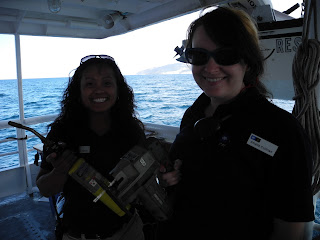

Deckies!!!!  Here are two of the four most valuable players onboard, Deckhands.  Sheryl and Amelia.  If you loose it, they find it.  If you break it, they fix it.  The deckhands work the hardest of hours. 12 on/12 off around the clock.  There is always 2 up in the middle of the night making sure everything is shipshape while we sleep.  They also hull the trash, check the engine room, paint the deck, load and unload passengers, etc,etc,etc.  MVP`s for sure!

Adam, the Bosun.  Adam has a very busy job buzzing back and forth from the ship in one of our 4 zodiacs full of passengers.  He is in charge of all the maintenance of these little guys and well as their appearance!
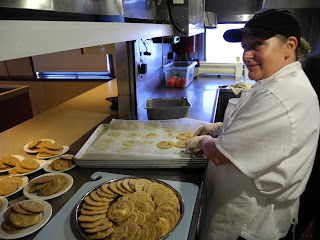
Probably the most popular of all crew, Carla.  Carla is the ships pantry chef. THE COOKIE BAKER.  Her cookies are so good, she has to hide them from the crew.  It`s a good thing too, because she might not have many left if she didn`t!  We love Carla!
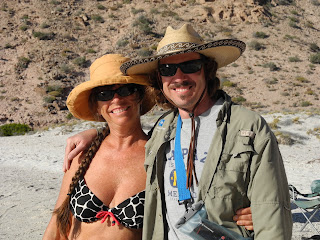
Aaaahhh the Naturalist.  Sheran and Alberto.  Here are 2 of the 6 or so Naturalist onboard.  If you have a question about the outside environment they will know the answer.  These guys assist the guests on their expeditions ashore as well as point out all the birds and whales that we see.  They are a wealth of knowledge.
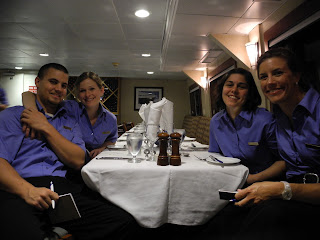
Here`s some of my crew.  The stewards!!!!!  This picture is taken just before dinner service.  Our job is to wait on the passengers and to tidy their rooms when they are out.  Sometimes we have to work in the Galley washing dishes too.  That my job next week, yikes!
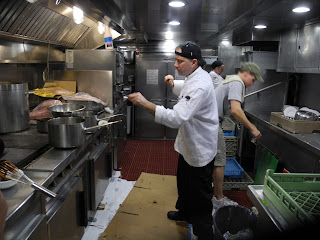
Our Executive chef, Singyn Hunter.  In this picture he is spinning sugar to don the dessert for the evening.  He is an excelent chef.  He not only makes the meals for guests, he is in charge of crew meals too.  He makes us sushi, chocolate-coconut breadpudding, nachos,Thai food.  All kinds of good stuff.  Gotta watch it with him onboard so you don`t gain too much weight!  Check out the Galley.  This small kitchen cooks for over 90 people....that`s a lot of dishes....

Michele Graves is our Expedition Leader.  Michele is a super organizer.  She, with the help of her husband, the captain, plan the day for the guests.  She has to take into account the direction of the wind, the tides, and the needs of the guests.  Michele is a very busy lady, but not too busy to give the weary crew a ride to la playa,(the beach) for the afternoon.  Thanks Michele!
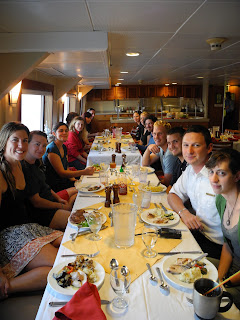
Christmas Dinner aboard the ship.  We decided to set the table and have a fancy dinner before we dressed and got ready for our shift.


Sunday, December 26, 2010

Happy Holidays from Baja!

One of the highlights from our Christmas Cruise was the abundance of wildlife!  We took Christmas morning and visited these sealions resting/barking on the rocks.  We were able to go snorkling with them at a distance.  The sealions can be pretty curious.  They come right up to check you out, maybe even a little nibble on your fin!  They eat a lot of fish and lounge on the rocks all day.


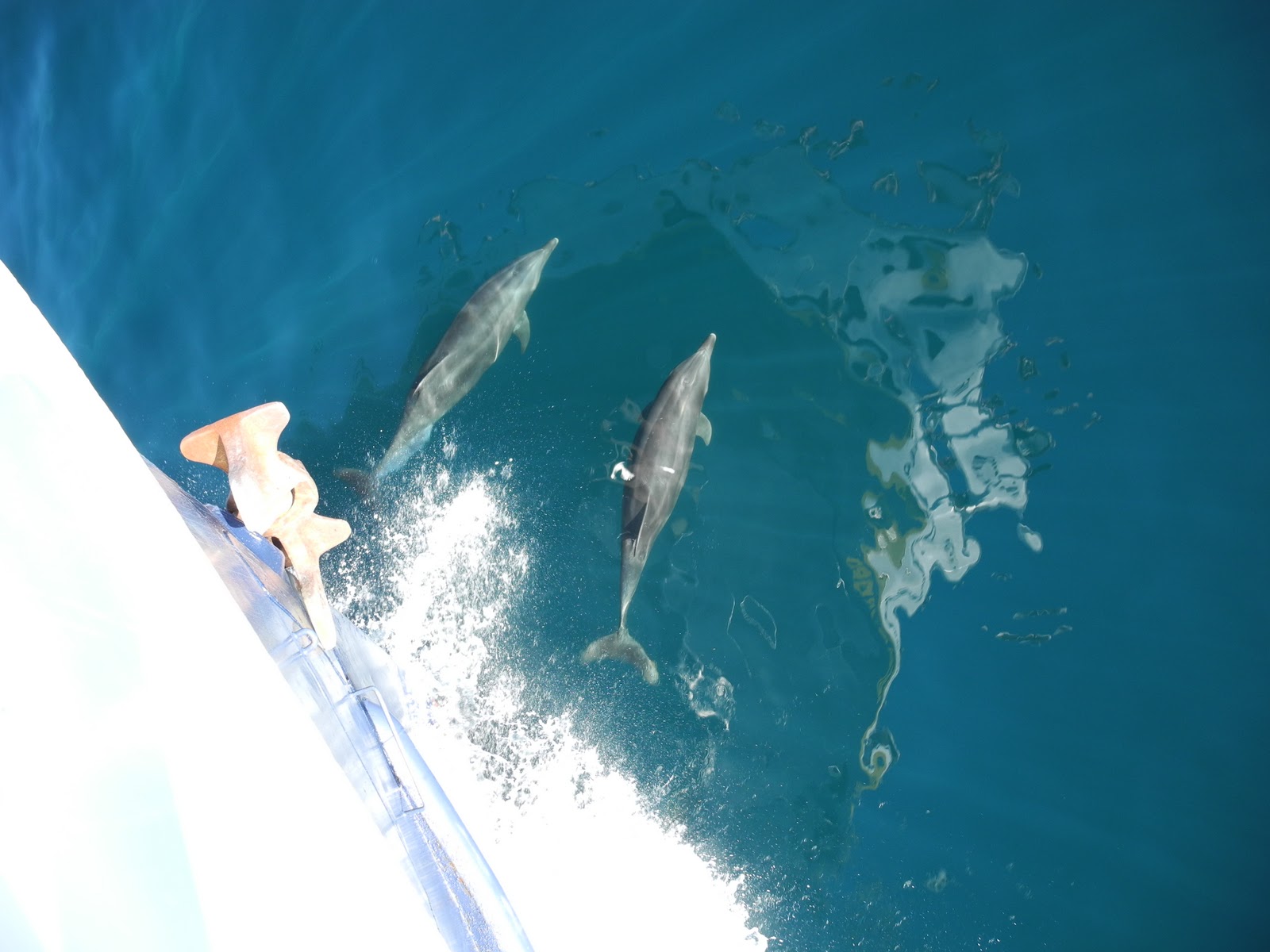
Bow-Riding~ Many cetaceans, especially dolphins, frequently ride the bow waves of boats and ships. They jostle for the best position, where they can be pushed along in the water by the force of the wave.  Some smaller cetaceans ride the bow waves of large whales in exactly the say way! Wow!


A Blowfish on the beach.  When these guys are threatened they blow up as big as a soccerball! 

A rare sighting, Pilot Whales!
Pilot Whale~There are a few different types of Pilot Whales and all are pretty similar.  The ones we have seen down here in Baja are the short finned Pilot Whale.  You can distinctly describe their tail as a wizards cap.  They travel in pods sometimes miles across.  Even though they are named a whale, they are in the Dolphin family, sometimes found in the company of them.  They are jet black or dark grey in color, with a rounded, bulbous head.  These whales have teeth. Fourteen to eighteen teeth are found on both the top and bottom.  You can see these Pilot Whales off the coast of Delaware in the Atlantic as well, although it is usually from a boat offshore. 


Bottlenose Dolphin~ The Bottlenose Dolphin varies greatly in size, shape, and color form one dolphin to the next. Dolphins are highly active on the surface; frequently bow-rides, wake-rides, body-surfs, rides pressure wakes, and breaches.  Dolphins are a very powerful swimmer.  You can find the Bottlenose Dolphin in all parts of the world except the far North. Dolphins have anywhere from 40-52 top teeth and 36-48 lower ones.  They use these teeth to feed on squid, octopus, fish, krill, or other crustaceans.  Their diet is kind of  like a great big sushi dinner!
 

Saturday, December 11, 2010

Positioning the ship from San Francisco to La Paz, Mexico

 Good Morning everyone and welcome to the National Geographic Motor Vessel Sea Bird.  We are an expedition vessel, meaning we conduct exploratory and adventure travel to remote locations. We are fully equipted with zodiacs for shallow water cruising, kayaks, and snorkle masks.  Thats my kind of cruise!  Even though I will be working here for the next few months, I plan on accessing some of the fun adventures this ship has to offer!

152 feet long
63   passengers
24   crew

Leaving San Farncisco Dec. 3rd Brrrrrrrr


We travelled South down the Pacific Coast of the Baja Penninsula, rounding the point at the very southern end, called Lands End, better known as Cabo San Lucas, and eventually turning North into the Gulf of California/Sea of Cortez.  Our final destination was the coastal town of La Paz on Dec 8th.